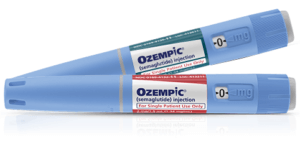
 Despite years of research and real-world use, there is still no FDA-approved testosterone therapy designed specifically for women.
Now, that gap is getting renewed attention.
Discussion around testosterone therapy for women has shifted in recent years, moving from the margins back into focus. More clinicians and patients are revisiting its potential role, particularly for postmenopausal women experiencing low sexual desire.
At the same time, the lack of an approved option in the United States continues to shape how testosterone is prescribed, dosed, and accessed. In many cases, treatment relies on off-label use or compounded alternatives, which can vary in consistency and oversight.
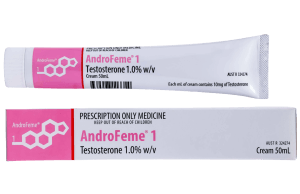
Outside the U.S., the approach looks different. AndroFeme, a testosterone cream developed in Australia, was specifically formulated for women and is available in a 1% dose. It is frequently referenced in clinical research and reflects a more tailored approach to testosterone therapy in female patients.
This evolving landscape raises important questions. What role does testosterone play in the female body? What does the current evidence actually show? And what does the absence of an FDA-approved option mean for women exploring their choices today?
Let’s take a closer look.
Why testosterone matters for women in menopause
Testosterone is often described as a male hormone, but the female ovaries and adrenal glands produce it throughout life. In the reproductive years, women actually circulate more testosterone than estrogen when the two are measured in the same units. Its role is quieter than estrogen’s, but it contributes to libido, mood, energy, cognitive sharpness, bone density, and lean muscle mass.
Testosterone behaves differently from estrogen during the menopause transition. Estrogen and progesterone fluctuate sharply through perimenopause and then decline steeply once menstruation ends. Testosterone declines more gradually, beginning in a woman’s twenties. For some women, the cumulative effect becomes noticeable around the menopausal years, surfacing as flagging libido, persistent fatigue, brain fog, or muscle weakness. These overlap considerably with the better-known symptoms of low estrogen, which is why specialists generally recommend optimizing standard menopause hormone therapy first before considering testosterone.
The clinical case for testosterone in postmenopausal women
 The strongest evidence for testosterone in women comes from double-blind, randomized, placebo-controlled trials in postmenopausal women diagnosed with hypoactive sexual desire disorder, or HSDD. HSDD is the clinical term for low sexual desire that causes personal distress and is not better explained by other factors such as antidepressant use, depression, vaginal dryness, or relationship problems.
In well-conducted trials, women with HSDD receiving low-dose transdermal testosterone reported, on average, one additional satisfying sexual event per month compared with placebo. They also reported gains in sexual interest, arousal, and pleasure, and a reduction in distress around their sex lives. The benefit is modest but meaningful for the women it helps. Evidence for testosterone use in premenopausal women is currently insufficient to support routine prescribing, although some specialists do prescribe it in selected cases.
Claims for testosterone beyond libido — meaningful gains in muscle mass, dramatic energy and cognitive improvements, broad anti-aging effects — are not yet supported by high-quality evidence at doses considered safe for women. Achieving substantial muscle effects generally requires pushing testosterone levels into the male physiological range, which carries its own risks. Decisions about whether testosterone replacement therapy is appropriate should be made with a qualified healthcare provider familiar with menopause medicine.
Why there is no FDA-approved testosterone for women
The clinical history is instructive. In December 2004, an FDA advisory panel reviewed Intrinsa, a testosterone patch developed by a leading U.S. drug manufacturer, for surgically menopausal women with HSDD. The patch worked. The panel still voted unanimously against approval, citing insufficient long-term data on cardiovascular and breast cancer risk. The decision came in the immediate aftermath of the 2002 Women’s Health Initiative findings, when caution around female hormone therapy was at its peak. The application was withdrawn.
A second attempt followed several years later. A specialist drug developer developed a testosterone gel for postmenopausal women with HSDD and ran a trial enrolling more than 3,500 women. The trial collected cardiovascular and breast cancer safety data that the FDA had requested, but the gel performed no better than the placebo on the efficacy endpoint. The product never received agency approval.
No new application for approval of testosterone in women has reached the FDA since. The result is a regulatory gap that other countries have chosen to close. Australia, New Zealand, South Africa, and the United Kingdom have authorized female-formulated testosterone products. American women, by contrast, are largely dependent on off-label prescribing of male products diluted to female doses, or on compounded preparations from specialty pharmacies.
How testosterone is currently used in women
Clinical guidelines from the Menopause Society and the International Society for the Study of Women’s Sexual Health point to transdermal delivery (absorption through the skin) as the preferred route. Applying testosterone to the skin avoids the liver processing that older oral testosterone preparations had to go through, and it allows for steady, predictable hormone levels rather than the sharp peaks and troughs that come with injections.
The target dose for menopausal women is generally 2 to 5 mg of testosterone daily. The aim is to restore levels into the upper range of what a healthy woman in her twenties or thirties would naturally produce, not to push them into the male range. Sex hormone binding globulin, a protein that carries testosterone in the blood, varies between individuals and influences how much active hormone reaches the tissues, which is one reason why dosing is rarely a simple matter of milligrams alone.
Three points commonly raised by specialists deserve attention:
- Baseline testosterone levels should be checked before starting therapy and rechecked a few weeks in. Periodic monitoring helps keep levels within the female range.
- If symptoms have not improved after about six months of well-monitored therapy, the usual recommendation is to stop. Testosterone is not a treatment to continue indefinitely without benefit.
- Pellets, which are implanted under the skin and release testosterone over months, are widely discouraged by specialists. Once placed, the dose cannot be adjusted, and pellets often produce levels well above the female physiological range.
Side effects at correctly monitored doses tend to be mild and reversible: minor skin irritation at the application site, occasional acne, or some local hair growth. At doses pushed into the male range, less reversible effects can occur, including scalp hair loss, voice deepening, and clitoral enlargement. Decisions about starting, adjusting, or stopping testosterone therapy belong with a healthcare provider who can monitor levels and individual response.
Where AndroFeme fits
AndroFeme is a 1% testosterone cream formulated specifically for women. It is manufactured in Australia, where it is approved for use in postmenopausal women with HSDD, and it is the female-formulated product most often cited in international guidelines. The bioidentical formulation matches the testosterone produced naturally by a healthy ovary, and the female-strength concentration is designed to deliver doses appropriate for women without the dilution arithmetic required by male gels. For clinicians and patients seeking precise, low-dose dosing, that purpose-built design is its central appeal.
Sourcing AndroFeme through IsraelPharm
For women whose physician has prescribed AndroFeme, accessing the branded product can be challenging in markets where it is not locally approved.
IsraelPharm is a licensed international pharmacy with experience in branded menopause and women’s health medications. It supplies AndroFeme as the original, female-formulated product, not a substitute. This matters in a category where compounded creams can vary in quality and where dose precision is important.
A valid prescription from a licensed physician is required. Treatment decisions and ongoing care remain under physician oversight, regardless of how the medication is sourced.
How to access testosterone replacement therapy through IsraelPharm
If your doctor has already prescribed AndroFeme, you can review the product and place an order through IsraelPharm with your prescription.
If you do not currently have a prescription, the next step is simple.
You can connect with a licensed telehealth provider through our trusted partner, Rxfor.me. This is a straightforward, confidential process that starts with a short online questionnaire. A U.S.-licensed healthcare provider will review your information and, if appropriate, issue a valid prescription.
Patients will receive a response within 24–48 hours.
👉 Start your consultation with Rxfor.me here
A Clear Path Forward
If you’re considering testosterone therapy and need a prescription, the fastest way to get started is through Rxfor.me.
If you already have a prescription, you can proceed directly through IsraelPharm.
Either way, there is a clear, supported path to access treatment with proper medical oversight.
A full explanation of the process can be found on the Rxfor.me website, along with more specific information about the specifics of sourcing AndroFeme.
Further reading
- AndroFeme product page at IsraelPharm
- IsraelPharm guide to testosterone replacement for women – IsraelPharm blog
- Menopause and lower interest in sex: an IsraelPharm overview – IsraelPharm blog
- Introducing Menopause Hormone Therapy – IsraelPharm blog
- The Menopause Society resources on female hormone therapy
- British Menopause Society guidance on testosterone replacement in menopause
Frequently asked questions about testosterone replacement therapy
What does testosterone replacement therapy do for women in menopause?
Testosterone replacement therapy is used mainly to address low sexual desire that causes personal distress in postmenopausal women. The strongest evidence is for HSDD. Other points to consider:
- Trials show modest but real improvements in libido and arousal.
- Standard menopause hormone therapy should usually be optimized first.
- Benefits beyond libido remain unproven at safe female doses.
- Treatment is reviewed at six months for response.
Why is there no approval of testosterone therapy for women in the United States?
No testosterone product for women has gained FDA approval to date. Two attempts were unsuccessful for different reasons. The history matters for understanding the current landscape:
- The 2004 Intrinsa patch was rejected over insufficient long-term safety data.
- The later BioSante gel failed to outperform placebo in trials.
- No new application has been submitted for approval of testosterone in women.
- Australia, New Zealand, South Africa, and the UK have approved products.
How is AndroFeme different from male testosterone gels?
AndroFeme is formulated at 1% testosterone, designed specifically for female dosing. Male gels typically deliver much higher concentrations and require dilution. Key differences include:
- AndroFeme delivers a female-appropriate dose without arithmetic guesswork.
- The hormone is bioidentical to natural ovarian testosterone.
- It is approved for women in Australia, where it is manufactured.
- It addresses the dose precision issues that complicate off-label male products.
What are the safety considerations with testosterone therapy for women?
At correctly monitored female doses, testosterone replacement therapy has a reassuring short-term safety profile. Side effects tend to be mild and reversible. Important points include:
- No short-term increase in breast cancer risk has been demonstrated.
- Mild skin irritation or local hair growth can occur at the application site.
- Doses pushed into the male range raise the risk of irreversible effects.
- Specialist advice is essential for women with a history of breast cancer.
Can testosterone therapy for women help with energy, muscle, or mood?
Claims about energy, mood, and muscle gains from testosterone are popular but not yet well supported by evidence at safe female doses. Realistic expectations matter. Specifically:
- Trial evidence for non-libido benefits in women remains limited.
- Substantial muscle gains usually require male-range doses.
- Male-range doses bring side effects that may not be reversible.
- Exercise and strength training remain essential alongside any therapy.
Glossary
- Androgen — A class of hormones, including testosterone, that influences male and female reproductive function and secondary sex characteristics.
- Bioidentical hormone — A hormone preparation chemically identical to the hormone the human body produces naturally.
- HSDD (hypoactive sexual desire disorder) — Persistently low sexual desire that causes personal distress and is not explained by other medical or relationship factors.
- Off-label prescribing — The legal practice of prescribing an approved medication for a use not listed on its official regulatory label.
- Perimenopause — The transitional years before menopause when ovarian hormone production fluctuates and menstrual cycles become irregular.
- Postmenopause — The phase of life that begins twelve consecutive months after a woman’s final menstrual period and continues thereafter.
- Sex hormone binding globulin — A blood protein that binds to sex hormones such as testosterone and influences how much circulates in active form.
- Supraphysiologic dose — A dose of a hormone that produces blood levels higher than the body would naturally make on its own.
- Transdermal — A delivery route in which medication is absorbed through the skin from a cream, gel, or patch into the bloodstream.