 For most women going through menopause, vasomotor symptoms are not a footnote. Hot flashes and night sweats often interrupt sleep, derail meetings, and soak clothing. They persist on average seven to nine years, and in roughly a third of women, longer than ten. About eighty percent of women experience vasomotor symptoms during the menopausal transition. Until recently, the only effective treatment was hormone replacement therapy (HRT), which not every woman can tolerate. Veozah (fezolinetant) was approved by the FDA in 2023. It is the first non-hormonal drug that directly targets the brain mechanism producing hot flashes. This article explains how Veozah works, who it is prescribed for, what the trial data shows, how it is dosed, and what is known about its safety.
What vasomotor symptoms are and what causes them
Vasomotor symptoms is the clinical term for hot flashes and night sweats. An episode of VMS is a sudden sensation of intense heat in the face, neck, chest, and upper back. It is often accompanied by flushing, sweating, and a racing heartbeat, and typically lasts a few seconds to several minutes. Night sweats are the same physiological event happening during sleep, with the added consequence of waking the woman up.
The driver sits in the hypothalamus, the brain region that regulates core body temperature. A small cluster of neurons there – KNDy neurons, named for their three signaling molecules (kisspeptin, neurokinin B, dynorphin) – helps set the thermoneutral zone. This is the narrow temperature range in which the body does not need to sweat or shiver. Estrogen normally restrains these neurons. When ovarian estrogen production declines, that restraint is removed. The KNDy neurons enlarge and become hyperactive. Neurokinin B signaling through the NK3 receptor increases. The thermoneutral zone narrows. Small temperature shifts that would normally pass unnoticed now trigger the full heat-dissipation response – vasodilation, sweating, the sensation of a hot flash.
This also explains why hormone therapy works. Replacing estrogen restores the brake on the KNDy neurons. It also explains why a drug that blocks the NK3 receptor would work: it intercepts the signal downstream, without using hormones.
How Veozah works: blocking the NK3 receptor
Veozah’s active ingredient, fezolinetant, is a selective antagonist at the neurokinin 3 receptor. It binds to the NK3 receptor on the KNDy neurons and prevents neurokinin B from activating them. With that pathway blocked, the thermoregulatory disruption that produces hot flashes is reduced at its source. 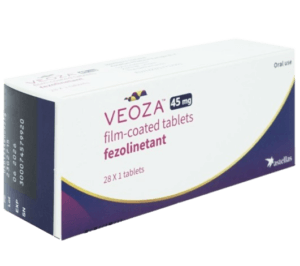
Two features of this mechanism are clinically important. First, fezolinetant acts independently of estrogen. It does not raise estrogen blood levels, does not act on estrogen receptors, and does not stimulate the uterine lining or breast tissue. That is what makes it a genuine option when hormone therapy is contraindicated. Second, the mechanism is targeted. Older non-hormonal options were repurposed from other indications and reduce hot flashes through indirect effects on serotonergic, noradrenergic, or autonomic pathways. Fezolinetant was designed for this indication.
Who Veozah is prescribed for
Veozah is approved for moderate to severe vasomotor symptoms due to menopause. In practice, it is most often prescribed for women who fall into one of two groups.
- Women with a contraindication to hormone therapy. This includes a history of breast cancer or another estrogen-sensitive tumor, prior venous thromboembolism, prior stroke or myocardial infarction, coronary heart disease, or an inherited high risk of clotting disease. For these women, an effective non-hormonal option was missing for a long time.
- Women who could take hormone therapy but choose not to – for personal preference, family history of hormone-sensitive cancer, or concern about long-term risk. Veozah gives the prescriber a clinically validated non-hormonal alternative for this group.
Veozah is not appropriate for women with known cirrhosis or severe renal impairment. It is also contraindicated alongside CYP1A2 inhibitors, discussed below.
What the clinical trial data shows
The two pivotal trials supporting FDA approval were SKYLIGHT 1 and SKYLIGHT 2. Both showed clinically significant reductions in the frequency and severity of moderate to severe VMS at 4 and 12 weeks versus placebo.
A 2025 systematic review and meta-analysis pooled six randomized controlled trials covering 3,657 participants. Compared with placebo, fezolinetant reduced VMS frequency at 4 weeks and at 12 weeks. It also reduced severity at both time points and improved Menopause-Specific Quality of Life scores.
A separate analysis compared the available pharmacological treatments for menopausal VMS head-to-head. HRT remained the most effective option overall. Among non-hormonal treatments, fezolinetant 45 mg significantly reduced both frequency and severity versus placebo. It ranked among the most effective non-hormonal options. The clinical takeaway: Veozah is not a substitute for hormone therapy where hormone therapy is suitable. For women who cannot or will not take it, Veozah sits at or near the top of the non-hormonal evidence base.
Dosing and how it is taken
Veozah is supplied as a 45 mg tablet. The standard dose is one tablet taken orally once a day, with or without food. Taking it at roughly the same time each day helps maintain steady blood levels.
If a dose is missed, it should be taken when remembered. If fewer than 12 hours remain before the next scheduled dose, skip the missed one. Never take two doses together.
Many women report a reduction in the number and intensity of hot flashes within the first week. Full effect is typically reached within four to twelve weeks of continuous daily use. Treatment should not be stopped abruptly without consulting the prescriber, as vasomotor symptoms may return.
Safety, warnings, and side effects
The most common side effects in clinical trials were abdominal pain, diarrhea, insomnia, back pain, hot flush (paradoxically), and elevations in liver enzymes. Most are mild and resolve over the first weeks.
Veozah carries a boxed warning for hepatotoxicity. Liver function tests are required before treatment and periodically during it. Women should promptly report dark urine, persistent nausea, right upper-quadrant pain, jaundice, or unusual fatigue to their prescriber.
Long-term safety data extends to roughly one year of continuous use. Beyond that, evidence is still accumulating. Treatment duration is a decision for the prescriber, made in light of symptoms, response, and overall risk profile.
How Veozah compares to other VMS treatment options
The table below sets Veozah alongside the main pharmacological alternatives for women with moderate to severe vasomotor symptoms.
| Treatment | Mechanism | Pros | Cons | Typical use |
|---|---|---|---|---|
| Veozah (fezolinetant) | Selective NK3 receptor antagonist; blocks neurokinin B signaling on KNDy neurons in the hypothalamus, restoring the thermoneutral zone. | Targeted, mechanism-specific. Non-hormonal. Effective against both frequency and severity of moderate to severe VMS. Useful when hormone therapy is contraindicated. | Boxed warning for hepatotoxicity; pre-treatment and periodic liver function tests required. Contraindicated with CYP1A2 inhibitors, cirrhosis, severe renal impairment. Long-term data limited to about one year. | Women with moderate to severe VMS who cannot or prefer not to use hormone therapy. |
| Systemic hormone therapy (estradiol, with or without a progestogen) | Replaces estrogen, restoring the hypothalamic brake on KNDy neurons and widening the thermoneutral zone. | Most effective treatment for moderate to severe VMS. Also addresses vaginal symptoms, protects bone density, and treats other menopausal complaints. | Small increases in risk of venous thromboembolism, stroke, gallbladder disease, and (with long-term combined use) breast cancer. Not suitable for women with a history of breast cancer, prior clotting events, or active liver disease. | First-line for women with moderate to severe VMS who have no contraindications. |
| Paxil (low-dose, FDA-approved for VMS) | Selective serotonin reuptake inhibitor; mechanism in VMS not fully understood but thought to involve serotonergic effects on thermoregulation. | Non-hormonal, oral, widely available. Low-dose 7.5 mg formulation specifically approved for VMS. | Smaller effect size than hormone therapy or Veozah. Sexual side effects, sleep disturbance, and nausea common. Significant drug interactions, particularly with tamoxifen. | Non-hormonal option for women who cannot take Veozah or hormone therapy, particularly where mood symptoms co-exist. |
| Effexor (off-label) |
Serotonin and noradrenaline reuptake inhibitors (SNRIs); reduce VMS through central neurotransmitter effects. | Non-hormonal. Useful when mood symptoms co-exist. Desvenlafaxine has trial evidence for VMS severity reduction. | Off-label for VMS in the US. Side effects include nausea, dry mouth, insomnia, and discontinuation symptoms if stopped abruptly. Smaller effect than hormone therapy. | Off-label non-hormonal option, often considered when SSRIs or Veozah are not tolerated. |
| Neurotonin (off-label) | Modulates calcium channel activity in the central nervous system; mechanism in VMS not fully established. | Non-hormonal. Often dosed at bedtime, which can help women whose primary complaint is night sweats and disturbed sleep. | Off-label for VMS. Sedation, dizziness, and weight gain are common. Effect on daytime VMS is more modest than on night sweats. | Off-label option, particularly where night sweats dominate the clinical picture. |
How to access Veozah for vasomotor symptoms through IsraelPharm
For women whose physician has prescribed Veozah, IsraelPharm is a licensed international pharmacy that supplies the branded medication against a valid prescription. The pharmacy operates under regulatory oversight. It dispenses the exact branded product the physician has written and ships it to the patient’s home. Physician oversight of treatment, including liver function monitoring, remains with the prescriber.
Three points are worth knowing. Legitimacy: a valid prescription from a licensed physician is required, and IsraelPharm is a licensed international pharmacy with deep experience in branded menopause medications. Access: IsraelPharm stocks branded Veozah and supplies the exact 45 mg tablet the FDA approved — not a substitute. Continuity: Veozah is taken daily under physician supervision, and reliable supply from one source avoids gaps between refills.
Women whose prescriber has decided that Veozah is the right choice can begin the order process by reviewing the menopause treatments category on the IsraelPharm website, where Veozah is listed alongside related products.
Further reading
- FDA prescribing information and safety updates for fezolinetant — FDA.
- Data supporting NK3 receptor antagonists for menopausal VMS — University of Illinois Chicago Drug Information Group.
- Vasomotor symptoms and menopause: SWAN findings — Thurston & Joffe (2011).
- 2023 nonhormone therapy position statement — The Menopause Society.
- HRT and the changing conversation around safety — IsraelPharm blog.
- Estrogen patch shortage: causes and what to do about it — IsraelPharm blog.
Frequently asked questions
How does Veozah for vasomotor symptoms differ from hormone replacement therapy?
Veozah is not hormone therapy. It contains no estrogen, no progesterone, and does not act on estrogen receptors.
- It blocks the NK3 receptor in the brain to reduce hot flashes.
- Hormone therapy replaces estrogen, which calms the same brain pathway indirectly.
- Veozah is an option when hormone therapy is unsafe or unwanted.
- It does not protect bone density or treat vaginal dryness.
- Hormone therapy remains the most effective single treatment for VMS overall.
How quickly does Veozah reduce vasomotor symptoms?
Veozah typically begins reducing the number and intensity of hot flashes within the first week of daily dosing.
- The reduction continues to deepen over the first four weeks.
- Full effect is usually reached by twelve weeks of continuous use.
- Daily dosing at roughly the same time helps maintain steady blood levels.
- Skipping doses or stopping abruptly often allows vasomotor symptoms to return.
- Consistency is the single biggest factor in symptom response.
What are the main safety concerns with Veozah?
The principal safety concern is liver injury, which carries a boxed warning on the FDA label.
- Pre-treatment and periodic liver function tests are required.
- Report dark urine, jaundice, persistent nausea, or right-sided abdominal pain promptly.
- Veozah is contraindicated in known cirrhosis and severe renal impairment.
- Drug interactions with CYP1A2 inhibitors are a strict contraindication.
- The prescriber should review every other medication being taken.
Who is a candidate for Veozah?
Veozah is most often considered for women with moderate to severe vasomotor symptoms who cannot or will not take hormone therapy.
- Women with a history of breast cancer or estrogen-sensitive tumors.
- Women with prior blood clots, stroke, or myocardial infarction.
- Women with active liver disease that does not amount to cirrhosis (with caution).
- Women who prefer a non-hormonal route after discussion with their physician.
- Eligibility is a clinical decision made by the prescriber.
Does Veozah help with other menopause symptoms beyond hot flashes?
No. Veozah is approved only for moderate to severe vasomotor symptoms and treats the hot flashes and night sweats specifically.
- It does not treat vaginal dryness or painful intercourse.
- It does not protect bone density or treat osteoporosis.
- It is not approved for mood symptoms, anxiety, or insomnia not driven by VMS.
- Other menopausal symptoms may need separate treatment from the prescriber.
- Sleep often improves indirectly when night sweats are reduced.
How is Veozah obtained through IsraelPharm?
IsraelPharm dispenses branded Veozah for vasomotor symptoms to patients holding a valid prescription from their physician.
- The prescription must name Veozah 45 mg tablets specifically.
- Orders are placed through an account on the IsraelPharm website.
- The branded product is shipped to the patient’s home address.
- IsraelPharm is a licensed international pharmacy with regulatory oversight.
- Liver function monitoring and clinical oversight remain with the prescriber.
Glossary
- CYP1A2: A liver enzyme in the cytochrome P450 family that metabolises fezolinetant; drugs that inhibit it can dangerously raise Veozah blood levels.
- Estradiol: The most potent natural form of estrogen produced by the ovaries and used as the active hormone in most menopausal hormone therapy products.
- Fezolinetant: The active ingredient in Veozah; a selective NK3 receptor antagonist that blocks neurokinin B signaling in the brain’s temperature-regulation center.
- Hepatotoxicity: Liver injury caused by a medication, ranging from mild enzyme elevation to serious damage; the basis of Veozah’s boxed warning.
- Hypothalamus: A small region at the base of the brain that regulates core body temperature, hormones, sleep, and other involuntary functions.
- KNDy neurons: A cluster of hypothalamic neurons named for kisspeptin, neurokinin B, and dynorphin; central to the brain mechanism that produces hot flashes.
- Neurokinin 3 (NK3) receptor: A receptor on KNDy neurons through which neurokinin B drives the thermoregulatory disruption underlying vasomotor symptoms.
- Neurokinin B: The signaling molecule that activates the NK3 receptor on KNDy neurons; its activity increases when estrogen production declines at menopause.
- Perimenopause: The transitional years before menopause, marked by irregular cycles and the start of significant hormonal fluctuation.
- SKYLIGHT trials: The two pivotal phase 3 trials that supported FDA approval of Veozah by showing reductions in VMS frequency and severity versus placebo.
- SSRI: Selective serotonin reuptake inhibitor; a class of antidepressants, one of which (low-dose paroxetine) is FDA-approved for vasomotor symptoms.
- Thermoneutral zone: The narrow core body temperature range in which the body does not need to sweat or shiver; this zone narrows in symptomatic perimenopausal women.
- Vasomotor symptoms: The clinical term for hot flashes and night sweats, the episodes of sudden heat, flushing, and sweating that affect most women during the menopausal transition.