When I was growing up, there used to be a running joke that was trotted out when we gathered around the table at family get-togethers. One of the younger cousins would speak up and say “I love this family, but the problem is, there’s too much heredity, and not enough inheritance!” In some way, this sardonic comment highlights an important distinction that many people miss, which is that heredity and inheritance are not the same thing. This old saying came back to me when I was reading an article in the latest edition of the New England Journal of Medicine, published January 24, 2026. The title is “Inheritance,” and it deals with a subject that resonates for me, because I share the author’s sentiments as she says in her opening lines “I come from a line of Ashkenazi Jews who have intermarried for as long as a genetic ancestry kit can detect.” Author Dr. Eve Rittenberg relates how she found out, as a participant in a population study, that she carried a gene that is more common in the European Jewish population, which carries an increased risk of breast cancer.

Understanding the difference between heritability and inheritance
Inherited risk is a phrase that often causes confusion. Many people hear it and assume that a health problem is guaranteed to happen. In reality, genetics usually deals in probabilities, not promises.
Heredity is the biological process that passes genes from parents to children. Every person receives half of their DNA from each parent. These genes act like instruction manuals that guide how the body grows, repairs itself, and functions day to day.
Basic genetics often follows patterns first described by Gregor Mendel. Some traits are linked to dominant genes, which show their effects even if only one copy is inherited. Others depend on recessive genes, where a person must inherit two altered copies, one from each parent, for the condition to appear.
Heritability is different. A heritability score describes how much of the variation in a trait across a whole population is linked to genetic differences. It does not measure how “genetic” one person’s condition is. Environment, lifestyle, and chance still play large roles.
Inheritance, in a medical sense, often refers to carrying a specific gene mutation that may increase disease risk. Even then, the presence of a mutation does not mean illness is predetermined.
To understand this, it helps to compare risk with the general baseline.
If a condition affects 1% of people in the wider population, and a certain mutation doubles that risk, the lifetime chance rises to 2%, not 50%. The number has increased, but it is still far from certain.
The BRCA2 mutation provides a clearer example. This mutation affects a gene that normally helps repair damaged DNA. When it does not work properly, the lifetime risk of certain cancers rises above the population baseline. However, many people with the mutation never develop cancer, and many people without it still do. Genes influence risk, but they do not write a fixed script.
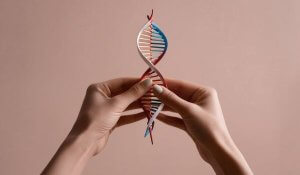
Dominant genes that cause severe illnesses are rare
Some conditions are very different. These are often called monogenic or single-gene disorders. In these cases, inheriting the altered gene is strongly linked to developing disease.
-
- Huntington’s disease is caused by a dominant mutation. A child of an affected parent has a 50% chance of inheriting the mutation and, if they do, will almost certainly develop symptoms later in life.
- Tay-Sachs disease is a severe genetic disorder caused by recessive mutations. A child must inherit two faulty copies to develop the condition. It also has a strong presence in people of European Jewish descent.
- Cystic fibrosis and sickle cell anemia are also recessive disorders with clear genetic causes.
- Descendants of Queen Victoria were at risk of inheriting hemophilia, a genetic bleeding disorder that prevents blood from clotting properly. Often referred to as the “royal disease,” this X-linked recessive condition was passed down through her daughters, affecting only male descendants, including in the Russian, Spanish, and German royal families.
These conditions are sometimes described as being close to 100% heritable in the sense that the mutation itself drives the disease. Even so, they are rare compared with common illnesses like heart disease, diabetes, or depression.
Most common inherited diseases are polygenic. That means they are influenced by many small genetic changes, each adding a little to risk. Environmental factors then act as switches that can increase or decrease the chance of illness.
-
- Diet and physical activity.
- Exposure to infections or toxins.
- Stress levels and sleep patterns.
- Access to medical care and early screening.
In these situations, genes load the dice, but they do not decide the final roll.

Large research efforts, including long-term population study projects, have helped scientists understand these patterns. By comparing health outcomes with genetic data across thousands of people, researchers can estimate how much genes contribute to disease risk and how much comes from environment.
The story described earlier about discovering a BRCA2 mutation through a research biobank highlights another key point. Many people carry higher-risk mutations without knowing it. Learning about these risks can feel overwhelming, but it also creates opportunities for informed consultations with healthcare professionals.
Importantly, high genetic risk does not rule out action. Medical history shows many examples where understanding inherited risk has led to earlier detection, closer monitoring, and better outcomes. This balance between knowledge and uncertainty is at the heart of modern genetics. Science can estimate risk with increasing accuracy, but it still cannot predict an individual future with certainty.
Frequently asked questions about heritability and inheritance
What does inherited risk really mean for an individual?
Inherited risk means that a person has genetic factors that may raise the chance of developing a certain condition compared with the general population. It does not mean the condition will definitely occur. Risk is influenced by many elements, including lifestyle, environment, and simple chance. A higher inherited risk is best seen as a signal for awareness and discussion with qualified healthcare professionals, rather than a prediction of a fixed outcome.
How is a heritability score different from a personal risk estimate?
A heritability score applies to groups of people, not to one individual. It describes how much of the variation in a trait across a population is linked to genetic differences. A personal risk estimate, on the other hand, looks at one person’s genes, family history, and other factors. Even if a condition has a high heritability score, an individual’s outcome can still vary widely depending on non-genetic influences.
Can someone have a gene mutation and never develop disease?
Yes, this happens often. Many gene mutations increase risk without guaranteeing illness. This is called reduced penetrance. Other genes, environmental exposures, and lifestyle factors can modify how a mutation affects the body. For this reason, genetic findings are usually discussed in terms of probability rather than certainty. Ongoing monitoring and medical guidance can help people understand what their specific results may mean.
Why are dominant genetic disorders rare?
Dominant genetic disorders that almost always cause disease tend to be rare because severe conditions often reduce the chance of passing the gene to the next generation. Over time, this limits how common these mutations become in the population. In contrast, common diseases usually involve many small genetic changes, each with a mild effect, which can persist widely without causing severe illness in most carriers.
What role does environment play when inheritance risk is high?
Environment can strongly influence whether a genetic risk turns into disease. Factors such as nutrition, physical activity, exposure to toxins, infections, and stress can interact with genetic tendencies. Even when inherited risk is high, supportive environments and appropriate medical care can sometimes delay onset, reduce severity, or help detect problems earlier. Genes set the stage, but environment often shapes the performance.
Should people take action based only on learning about a gene mutation?
Genetic information is most useful when discussed with qualified healthcare providers who understand both the science and the individual’s medical history. Decisions about screening, monitoring, or other steps depend on many factors beyond a single test result. Genetic findings can guide thoughtful planning, but they are only one part of a much larger health picture.