 Deep vein thrombosis (DVT) is a condition where a blood clot forms inside a deep vein, most often in the leg. If a piece of that clot breaks loose and travels to the lungs, it can cause a pulmonary embolism – a medical emergency requiring immediate attention. To prevent these events, doctors often prescribe an anticoagulant. One of the preferred treatments of DVT is Xarelto (rivaroxaban) is one of the most widely prescribed oral anticoagulants in the United States today, and it represents a major step forward in how we treat and prevent thromboembolic disorders.
Rivaroxaban belongs to a newer family of medicines known as novel oral anticoagulants (NOACs), or direct oral anticoagulants (DOACs). It works by directly blocking a key step in the blood coagulation cascade. Compared to older drugs like warfarin, Xarelto offers more predictable dosing, fewer dietary restrictions, and no need for routine blood-test monitoring. That convenience is a real clinical advance, but the risk of blood thinners has not gone away. Every anticoagulant, Xarelto included, increases the chance of bleeding, and patients deserve a clear, honest picture of what that means in everyday life.
This article explains how Xarelto works, the safety of anticoagulants, who it’s prescribed for, what the safety profile really looks like, and what to watch for during treatment. The information here is meant to support, not replace, the guidance you receive from your own doctor.
A brief look at Deep Vein Thrombosis
Before diving into the medication, it helps to understand the condition that often leads to an Xarelto prescription. DVT happens when blood clots form in the deep veins of the legs (and sometimes the pelvis or arms). The clot may partially or completely block blood flow, causing pain, swelling, warmth, and redness in the affected limb.
The bigger danger is what happens if a clot breaks free. It can travel through the bloodstream to the lungs and lodge in a pulmonary artery – a pulmonary embolism. Sudden shortness of breath, chest pain, and coughing are warning signs that need immediate medical attention.
DVT is closely linked to several other conditions that anticoagulants treat or prevent, including stroke and systemic embolism in patients with non-valvular atrial fibrillation (a common cardiac arrhythmia), and inherited blood-clotting disorders such as Factor V Leiden and Antiphospholipid Syndrome. Understanding this wider picture explains why Xarelto has so many approved uses.
How Xarelto works: A direct Factor Xa inhibitor
 Your body is constantly balancing two opposing processes – clotting and anti-clotting. When you cut yourself, a chain reaction of proteins called the blood coagulation cascade quickly forms a clot to stop the bleeding. The trouble starts when clots form where they aren’t needed, or grow larger than they should.
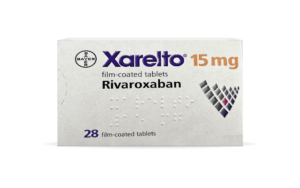
Xarelto’s active ingredient, rivaroxaban, is a factor Xa inhibitor. Factor Xa (pronounced “factor ten-A”) is a protein that sits at a critical junction of the coagulation cascade. It converts prothrombin into thrombin, and thrombin is what turns liquid fibrinogen into the fibrin strands that hold a clot together. By directly blocking factor Xa, rivaroxaban interrupts this chain reaction before thrombin is produced, which means clots are less likely to form and existing clots are less likely to grow.
This is a different approach from warfarin, which is a vitamin K antagonist. Warfarin lowers the body’s production of several vitamin K-dependent clotting factors, but its effect is slow, indirect, and heavily influenced by diet. Xarelto’s effect is more targeted and more predictable from one day to the next. That predictability is the reason patients on Xarelto don’t need the regular International Normalized Ratio (INR) blood tests that warfarin requires.
It’s worth noting that anticoagulants like Xarelto are not the same as antiplatelet medications such as aspirin or clopidogrel. Antiplatelets prevent platelets from sticking together, while anticoagulants interrupt the coagulation cascade itself. The two classes are sometimes used together for specific cardiovascular conditions, but they are not interchangeable. As always, decisions about combining or switching medications should be made with your prescribing physician.
What Xarelto is prescribed for
In the United States, Xarelto is approved by the FDA for several uses, all related to preventing or treating dangerous blood clots:
- Treatment of DVT and pulmonary embolism (PE), and reduction in the risk of recurrence after initial treatment.
- Prevention of stroke and systemic embolism in patients with non-valvular atrial fibrillation.
- Prevention of DVT following hip or knee replacement surgery.
- Reduction of the risk of major cardiovascular events in certain patients with coronary artery disease or peripheral artery disease (typically combined with low-dose aspirin).
One important limitation: Xarelto is not appropriate for patients with mechanical (prosthetic) heart valves or for those with moderate to severe mitral stenosis from rheumatic disease. In those situations, warfarin remains the standard. This is something your cardiologist and prescribing physician will determine based on your full clinical picture.
Dosing and how to take Xarelto in the treatment of DVT
Rivaroxaban is taken by mouth, once or twice a day, depending on the indication. The standard adult doses in the United States are:
- Stroke prevention in non-valvular atrial fibrillation: 20 mg once daily, taken with the evening meal. A reduced dose of 15 mg once daily is used for patients with reduced kidney function.
- Treatment of DVT or PE: 15 mg twice daily for the first 21 days, then 20 mg once daily for ongoing treatment.
- Reducing the risk of recurrent DVT/PE after at least 6 months of standard treatment: 10 mg once daily.
- DVT prevention after hip or knee replacement: 10 mg once daily.
- Cardiovascular risk reduction in CAD or PAD: 2.5 mg twice daily, in combination with aspirin.
Doses of 15 mg and 20 mg should be taken with food, because food significantly improves how much of the drug is absorbed. The 10 mg and 2.5 mg doses can be taken with or without food.
Take Xarelto at the same time each day. If you miss a dose:
- For once-daily dosing, take the missed dose as soon as you remember on the same day. If you don’t remember until the next day, skip it – never double up.
- For twice-daily dosing, take the missed dose right away to keep your daily total correct, even if it means taking two doses close together. The next day, return to your normal schedule.
Do not stop Xarelto suddenly without speaking to your doctor first. Stopping early raises the risk of stroke or another clotting event, and any switch to a different anticoagulant needs to be carefully managed.
This article describes general dosing information. Your individual dose, schedule, and treatment duration should always be confirmed with your prescribing physician.
The safety profile: Understanding the risk of blood thinners
Anticoagulants do exactly what their name suggests. They slow your blood’s ability to clot. That’s the benefit, and it’s also the source of the risk. The most important and most common adverse effect of Xarelto, like every other anticoagulant, is bleeding.
Common and expected effects
Most people on Xarelto find that they:
- Bruise more easily, often from bumps too minor to notice.
- Bleed longer from small cuts, scrapes, or shaves.
- Take longer to stop nosebleeds.
- Notice heavier menstrual bleeding (in women).
These effects are part of how the medication works. They are not usually dangerous on their own, but they’re a signal that the drug is active in your system.
Serious bleeding: Warning signs
Major bleeding is uncommon but is the most serious risk associated with Xarelto. Contact your healthcare provider promptly, or seek emergency care, if you notice any of the following:
- Vomiting blood, or material that looks like coffee grounds.
- Coughing up blood.
- Red, dark brown, or black urine.
- Bright red, dark, or tar-black stools.
- Nosebleeds lasting more than 10 minutes that won’t stop with pressure.
- Severe, unexplained, or spontaneous bruising.
- Heavy or unusual vaginal bleeding.
- A sudden severe headache, weakness on one side, vision changes, or confusion (possible signs of bleeding in the brain).
- Sudden severe back pain.
- Difficulty breathing or chest pain.
You should also seek emergency care if you are involved in a major accident, suffer a significant blow to the head, or cannot stop bleeding from any cause.
Compared to warfarin, rivaroxaban has been shown in clinical trials to carry a lower risk of intracranial (brain) bleeding, one of the most feared bleeding complications. However, gastrointestinal bleeding may occur somewhat more often with rivaroxaban than with warfarin. The overall safety profile is favorable for many patients, but the right medication for any individual depends on personal risk factors, kidney function, age, and other medications. Your doctor is the best person to weigh these tradeoffs with you.
Other side effects
Beyond bleeding, Xarelto may also cause:
- Indigestion, stomach pain, or nausea.
- Diarrhea or constipation.
- Headache or dizziness.
- Fatigue.
- Skin rash or itching.
Most of these are mild and resolve over time. Persistent or severe side effects should be discussed with your doctor.
Who should be cautious with Xarelto
Some conditions either rule out Xarelto or call for extra caution:
- Severe kidney impairment: Rivaroxaban depends partly on the kidneys to clear from the body, and reduced kidney function increases bleeding risk.
- Active major bleeding or recent major surgery.
- A history of bleeding in the brain (such as a hemorrhagic stroke or recent aneurysm).
- Severe liver disease, especially if it affects clotting itself.
- Pregnancy and breastfeeding: Rivaroxaban is not recommended during pregnancy or while breastfeeding because there isn’t enough evidence to confirm it is safe for the baby.
- Mechanical heart valves or moderate-to-severe mitral stenosis: Warfarin is required instead.
How Xarelto Compares to Other Anticoagulants
Xarelto is one of several oral anticoagulants commonly prescribed for DVT. The table below provides an overview of how rivaroxaban compares to other widely used options. It is not intended as guidance on switching medications. That decision belongs with your physician.
| Medication | Class | Dosing | Routine Blood Monitoring | Specific Reversal Agent | Notable Considerations |
|---|---|---|---|---|---|
| Xarelto | Direct factor Xa inhibitor | Once or twice daily depending on indication | Not required | Andexanet alfa (Andexxa) | Take 15/20 mg doses with food; not for mechanical heart valves |
| Eliquis | Direct factor Xa inhibitor | Twice daily | Not required | Andexanet alfa (Andexxa) | Lower rates of GI bleeding observed vs. warfarin |
| Pradaxa | Direct thrombin inhibitor | Twice daily, with food | Not required | Idarucizumab (Praxbind) | Higher rate of indigestion; kidney function important |
| Savaysa | Direct factor Xa inhibitor | Once daily | Not required | Andexanet alfa (Andexxa) | Not recommended in patients with very high kidney function |
| Warfarin | Vitamin K antagonist | Once daily | Required (regular INR tests) | Vitamin K, prothrombin complex | Diet and drug interactions affect dose; required for mechanical heart valves |
Sourcing Xarelto for long-term treatment through IsraelPharm
Xarelto is typically prescribed for months or years, and in many cases for life. That makes consistent, reliable access to the medication essential; interruptions in supply can put patients at increased risk of clotting events.
IsraelPharm is a fully licensed pharmacy with extensive experience supplying Xarelto and other anticoagulants to patients for the treatment of DVT and other long-term cardiovascular and clotting conditions. IsraelPharm requires a valid prescription from your physician before dispensing rivaroxaban, and your physician’s oversight of your treatment continues unchanged.
What patients value most is reliability: our pharmacy stocks the genuine, manufacturer-supplied branded Xarelto product, not a substitute or repackaged version, and ensures that ongoing prescriptions are filled and shipped without gaps in supply. For a medication where missing doses carry real clinical consequences, that continuity matters. The fact that IsraelPharm’s pricing is often considerably lower than US retail is a meaningful supporting benefit for long-term users, but the foundation of the service is pharmaceutical quality and consistent access.
Our role is straightforward: source, dispense, and deliver the prescribed product accurately and on schedule.
Frequently asked questions about the treatment of DVT
1. What does Xarelto actually do inside the body?
Xarelto’s active ingredient, rivaroxaban, is a direct factor Xa inhibitor. Factor Xa is a protein that triggers the production of thrombin, which is what turns liquid blood components into a solid clot. By blocking factor Xa, Xarelto interrupts the blood coagulation cascade earlier in the process, making it harder for harmful clots to form or grow. The clot-forming machinery still works enough to handle normal injuries, but the threshold for inappropriate clotting is raised.
2. Why don’t I need regular blood tests on Xarelto, like I would on warfarin?
Warfarin’s effect varies a lot from person to person and changes with diet, other medications, and even illness. INR tests are how doctors check that the dose is in the right range. Rivaroxaban has a much more predictable effect in the treatment of DVT at standard doses, so routine INR testing isn’t required. You’ll still see your doctor periodically to review kidney and liver function, check for any bleeding problems, and confirm the medication is being taken correctly, but you won’t need a blood test before every dose change.
3. What is the most serious risk I should know about?
The most serious risk of Xarelto, and of every anticoagulant, is major bleeding. This is the underlying answer to questions about the risk of blood thinners. Most bleeding events are minor – easy bruising, longer bleeding from cuts – but in rare cases, serious bleeding can occur in the gastrointestinal tract or, even more rarely, in the brain. Watch for the warning signs listed earlier in this article and seek prompt medical attention if any appear.
4. Can I drink alcohol or eat certain foods while on Xarelto?
Unlike warfarin, rivaroxaban is not significantly affected by vitamin K-rich foods such as leafy green vegetables, so you don’t need to maintain a special diet. Moderate alcohol use is generally acceptable, but heavy drinking should be avoided. Alcohol can irritate the stomach lining and increase bleeding risk. Always confirm with your physician based on your individual health profile.
5. What happens if I need surgery or a dental procedure?
Tell every healthcare provider, including dentists, that you take Xarelto. For most planned procedures, your doctor will give you specific instructions about when to pause the medication beforehand and when to restart it. The exact timing depends on the procedure’s bleeding risk and on your kidney function. Never stop Xarelto on your own; the goal is to balance the risk of clotting against the risk of bleeding during the procedure.
6. How do I source Xarelto reliably for ongoing treatment?
Xarelto is usually a long-term treatment of DVT, which makes a consistent supply important. Your prescribing physician writes the prescription and decides on the dose, and you choose where to fill it. IsraelPharm is one option for US patients: a licensed pharmacy that requires a valid prescription, supplies the genuine branded Xarelto product, and ships directly to your address. Whichever pharmacy you choose, the goal is the same – uninterrupted access to your prescribed medication so your treatment stays on track.
Glossary
- Anticoagulant: A medication that reduces the blood’s ability to form clots. Often called a “blood thinner,” though it does not literally make the blood thinner.
- Antiplatelet: A different class of medication (such as aspirin or clopidogrel) that prevents platelets from sticking together. Distinct from anticoagulants, although both reduce clot formation.
- Atrial fibrillation (non-valvular): A cardiac arrhythmia in which the upper chambers of the heart beat irregularly. Increases the risk of clots forming in the heart and traveling to the brain.
- Blood coagulation cascade: The series of chemical reactions, involving multiple clotting factors, that converts liquid blood into a solid clot at the site of an injury.
- Deep vein thrombosis (DVT): A blood clot that forms in a deep vein, most commonly in the leg.
- Direct oral anticoagulant (DOAC): A class of newer oral anticoagulants that act directly on a specific clotting factor. Includes rivaroxaban, apixaban, edoxaban, and dabigatran. Sometimes called novel oral anticoagulants (NOACs).
- Factor Xa: A clotting protein (factor “ten-A”) that plays a central role in producing thrombin. The target of rivaroxaban in the treatment of DVT.
- INR (International Normalized Ratio): A standardized blood test that measures how quickly blood clots. Used to monitor warfarin therapy. Not required for Xarelto.
- Pulmonary embolism (PE): A blockage in one of the arteries of the lungs, usually caused by a blood clot that has traveled from elsewhere in the body. A medical emergency.
- Prothrombin: A protein in the blood that is converted by factor Xa into thrombin. Thrombin then drives the final steps of clot formation.
- Stroke: Damage to the brain caused by interrupted blood flow, often from a clot blocking a blood vessel (ischemic stroke) or, less commonly, by bleeding (hemorrhagic stroke).
- Systemic embolism: A clot that travels through the bloodstream and blocks a blood vessel somewhere other than the lungs.
- Thromboembolic disorders: Medical conditions in which clots form inappropriately in blood vessels, then travel and cause damage elsewhere. DVT, PE, and stroke from atrial fibrillation are common examples.
- Vitamin K-dependent clotting factors: Several proteins (including factors II, VII, IX, and X) require vitamin K to be produced by the liver. Warfarin works by interfering with this process. Xarelto does not.